


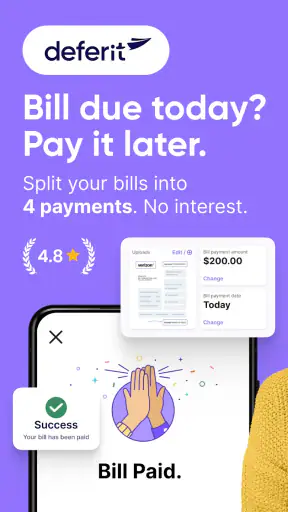
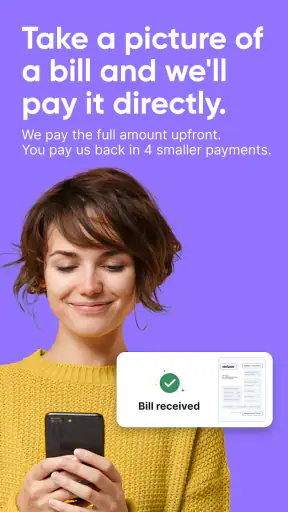
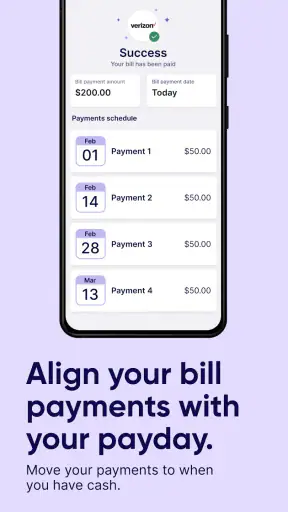
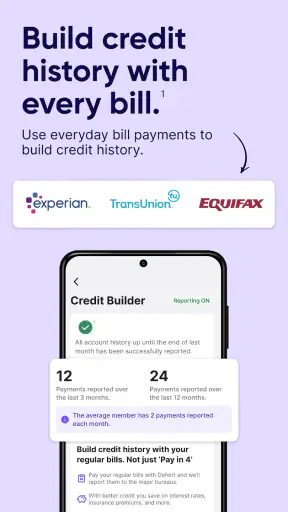

When a bill arrives at the wrong moment, the problem is often timing rather than the total amount. Deferit: Split Bills, Pay in 4 is a finance app from Deferit built around that situation. Instead of treating a bill as one large payment, it lets eligible users divide it into four smaller payments without interest, according to its store summary. I approached it as a practical budgeting tool rather than a general banking replacement, and that distinction matters from the first screen.
The app is free to download and is rated for Everyone, so the basic entry point is straightforward for a wide audience. It has reached over one million installs and holds a 4.5 average from around twenty thousand ratings, with roughly two thousand reviews. Those figures suggest that the idea is easy to understand and useful to many people, but they do not remove the need to examine how well the payment schedule fits your own income.
How Deferit fits into everyday bill planning
In normal use, I see the app as a short-term cash-flow tool. It is not designed to make a bill disappear, and it does not turn an unaffordable expense into a cheaper one. The amount still has to be covered; the difference is that the payment is organized into four parts. That can be helpful when a paycheck arrives after a due date, when several regular expenses land together, or when an unexpected bill would otherwise consume most of a week’s spending money.
The most useful way to think about it is as a bridge between today’s obligation and the next few points in your budget. Before using it, I would write down the full bill, the dates of the four scheduled payments, and the money already committed to rent, food, transport, subscriptions, and debt. Splitting one bill can create breathing room, but splitting several bills at once can make future weeks more crowded than the present one.
That is the first non-obvious trade-off: the app can smooth a difficult payment, yet the same convenience can hide how much of next month’s income has already been allocated. I would use it with a written calendar, not as a replacement for one. A simple note showing each installment date is enough to reveal whether the arrangement genuinely helps or merely postpones pressure.
What the free download does and does not tell you
There is no purchase price attached to downloading the app. That makes it reasonable to install and inspect the available flow before deciding whether it suits your circumstances. However, “free” should be read carefully here: it describes access to the app, not a promise that every possible account outcome, eligibility decision, or payment arrangement will be identical for every user. I would review the terms shown inside the app before committing to a bill.
This distinction is important when comparing it with ordinary bill payment. Paying a provider directly may be simpler and may avoid creating another scheduled obligation. On the other hand, direct payment does not usually offer the same four-part structure. Deferit’s value therefore comes from timing and organization, not from reducing the original bill.
I also would not compare it casually with a traditional credit card. A card can offer a reusable spending line, while this app is focused on dividing bill payments. A card may be more flexible for someone who needs a broad emergency buffer, but it can also encourage unrelated spending and may involve interest depending on how it is managed. Deferit is more narrowly focused, which is a strength for a person who wants help with bills rather than another general-purpose spending tool.
A realistic month when the split can help
Imagine that a utility bill arrives just before a payday, while groceries and transport costs are already due. Paying the full amount immediately could leave almost nothing for the next several days. In that situation, dividing the bill into four scheduled payments may protect the short-term budget and make the expense easier to absorb.
My advice would be to check the second, third, and fourth payments before accepting the arrangement. The first payment is the easy part to notice because it solves the immediate problem. The later payments are where the real affordability test happens. If one of them falls during rent week or alongside another large bill, the app may not be the right answer even though the initial payment looks manageable.
A second useful workflow is to reserve the later amounts as soon as the arrangement is created. I would move those amounts mentally, or physically in a separate budgeting space, rather than treating the remaining balance as available spending money. This turns the app from a last-minute rescue into a planned cash-flow method.
Where the app delivers real value
The clearest benefit is predictability. Four smaller payments can be easier to place into a weekly or fortnightly budget than one large withdrawal. That is especially relevant for people whose income is regular but whose bill dates are inconvenient. It may also help someone avoid choosing between one bill and essential daily spending during a particularly tight week.
Another strength is focus. Because the product is specifically about bills, the concept is less distracting than a broad shopping-focused pay-later service. I would be more comfortable recommending it to a person who has identified one known expense and a clear repayment plan than to someone looking for extra spending power.
The no-interest wording in the store summary is central to the appeal. It means the advertised structure is about dividing the payment rather than adding interest to the bill. Even so, I would read every confirmation screen carefully, especially any information connected with eligibility, timing, missed payments, or account conditions. A simple headline should never replace checking the exact arrangement presented for your bill.
One practical advantage is that the app can encourage a more deliberate decision. Instead of reacting to a due date with a rushed card payment or borrowing from a friend, you can examine the schedule and decide whether the four-part plan fits. That pause is valuable. It makes the cost visible over time, which is often more useful than a vague feeling that the bill is “smaller.”
The friction I would want users to understand
The biggest limitation is that splitting a bill does not improve income. It changes the timing of the outflow. If your budget is already short every week, four installments may simply distribute the problem across more dates. I would skip the app if I could not identify where each future payment would come from.
There is also a mental-accounting risk. A smaller first payment can feel harmless, particularly when several expenses are handled in the same way. The danger is not necessarily one arrangement; it is the accumulation of overlapping schedules. I would avoid creating multiple plans without first listing their combined future payments in one place.
Another point is that a finance app should not be treated as an emergency fund. An emergency fund remains available for an unexpected event, while a split-bill arrangement creates a commitment. If using Deferit would consume money needed for medicine, housing, food, or essential travel later in the month, I would look for a different solution first.
People who prefer the simplest possible setup may also find ordinary payment better. If you already have enough money available and paying the provider directly causes no difficulty, adding a separate schedule may not deliver meaningful value. The app earns its place when payment timing is the problem, not when the bill is already easy to pay.
Questions I would answer before accepting a plan
The first question is whether the bill is eligible and whether the proposed schedule is shown clearly before confirmation. I would not assume that every type of bill or every situation works identically. I would enter the process far enough to understand the available arrangement, then check the total amount and each payment date before proceeding.
The second question is whether the four payments match my actual income cycle. If I am paid weekly, the structure may be easier to map than if my income is irregular. Someone with variable freelance income should be especially cautious: a plan that looks comfortable during a strong week can become difficult when the next payment is delayed.
The third question is what happens if circumstances change. Before relying on the app, I would look for the in-app information about payment timing and account responsibilities. I would not build a budget that assumes a missed payment can be ignored or automatically rearranged.
The fourth question is whether I am using the app for a one-off timing gap or to cover a permanent shortfall. The first situation can be a reasonable use case. The second is a warning sign that the underlying budget needs attention. No split-payment tool can replace reducing expenses, increasing income, or seeking appropriate financial advice when the numbers do not work.
Who is likely to get the most value
I think the best match is a person with a predictable income, a specific bill, and enough total money to cover the expense over time. That user is not trying to borrow indefinitely; they are trying to align a payment with the rhythm of their budget. The app may also suit someone who wants a dedicated bill-focused option instead of using a credit card for a single household expense.
It can be useful for people who are organized enough to track several future dates. The four-payment format rewards planning. I would recommend setting reminders in whatever calendar or budgeting system you already use, because relying only on memory is unnecessary when the whole point is better control of timing.
I would be more hesitant for anyone with unstable income, existing overdue debts, or no room for essential expenses. It is also not a good fit for someone who tends to interpret installment payments as permission to spend more. In those cases, paying directly, negotiating with the bill provider, using an existing emergency reserve, or getting independent financial guidance may be safer.
App maturity and platform details
Deferit released the app on October 28, 2021, and the current version is 3.0.6. It supports Android 7.0 and later, which covers many older devices. That broad compatibility is helpful if you are using an older phone for financial tasks, although I would still keep the operating system updated whenever possible and install finance apps only through the official app marketplace.
The age rating is Everyone, but the subject matter is still financial and deserves adult judgment. An accessible rating does not mean that a payment schedule is suitable for every household. I would involve the person who actually manages the family budget before setting up a plan, particularly when bills are shared.
The developer is Deferit, the same name associated with the service itself. That makes the app’s purpose easy to identify, but I would still check the developer name carefully when installing, since finance apps are exactly the kind of software where choosing an imitation would be risky.
My recommendation after weighing the value
My overall view is positive but conditional. Deferit offers a clear form of value because the download is free and the central proposition is easy to understand: divide a bill into four smaller, interest-free payments. The benefit is strongest when a temporary timing mismatch is the only obstacle. In that situation, the app can make a difficult week more manageable without turning the user toward general shopping credit.
That value disappears when the budget cannot support the later payments. I would not use it to cover recurring overspending, to maintain a lifestyle that income cannot support, or to stack several commitments without a complete payment calendar. The app is a scheduling tool, not a solution to a persistent deficit.
For a careful user, I would start with one bill, inspect the full schedule, and record every future payment before confirming. I would then reassess whether the remaining budget still covers essentials. This small discipline addresses the most important weakness of installment products: the temptation to focus on today’s smaller amount while forgetting tomorrow’s obligations.
My verdict: try Deferit when the problem is bill timing and you can comfortably cover all four payments; skip it when your total budget is already insufficient. It is a focused finance app with a useful free entry point, a strong fit for planned short-term cash-flow management, and a poor fit for anyone looking for permanent financial relief. Used with a calendar and an honest budget, it can be practical. Used without those safeguards, its convenience can make future pressure harder to see.


